


Quick Summary
- The Job Market: Charlotte is one of the largest banking centers in the country, and Raleigh’s Research Triangle draws tech and life sciences employers. South Carolina leans on manufacturing, and both states have large military bases.
- Cost of Living: Both states come in below the national average overall. Housing costs climb quickly in the big metros and along the coast, so your budget depends heavily on where you settle.
- Where to Live: Most of the big cities in the Carolinas sit within a few hours’ drive of both the beach and the mountains.
- The Weather: Winters stay mild and summers run hot and humid. If you’re moving to the coast, plan around hurricane season, which runs June through November.
North Carolina and South Carolina have spent years near the top of the list of places Americans want to move. In moveBuddha’s 2025–2026 Migration Report, South Carolina drew more interest from people looking to move in than any other state, and North Carolina ranked third.
Living in North Carolina and living in South Carolina have a lot in common, including mild winters and plenty of small-town Southern hospitality. But taxes and housing prices can look pretty different depending on which side of the state line you pick.
If you’re thinking about moving to South Carolina or North Carolina, let’s walk through how the two states compare, along with some of the best places to live in the Carolinas, so you can narrow down your search before you start packing.
Welcome to the Carolinas
Welcome to the Carolinas! The two states share a border and a serious love of barbecue, but each one has its own personality.
- Population: About 11.2 million people live in North Carolina and about 5.6 million live in South Carolina, according to 2025 Census estimates.
- Growth: South Carolina had the fastest population growth rate in the country in 2025, and North Carolina ranked third.
- Big Cities: Charlotte is the largest city in the Carolinas, and Raleigh passed 500,000 residents in 2025.
- Landmarks: Famous for the Blue Ridge Parkway, the Outer Banks, the Biltmore Estate and Charleston’s historic waterfront.
- Food: Home to a friendly barbecue rivalry between North Carolina’s vinegar-based sauces and South Carolina’s mustard-based style.
- Sports: College rivalries run deep, especially Duke vs. UNC basketball and Clemson vs. South Carolina football, and Charlotte is home to the NFL’s Panthers and the NBA’s Hornets.
- Weather: Winters stay mild, while summers run long and hot.
North Carolina vs. South Carolina
On a map, the two Carolinas look like a matched set. Once you compare costs and taxes side by side, though, you’ll find a few clear differences that can shape where you decide to live.
- Nickname: The Tar Heel State vs. the Palmetto State
- Cost of living: About 5.7% below the national average in NC and 6.3% below in SC
- State income tax: A flat 3.99% in NC, compared to brackets of 1.99% and 5.21% in SC
- Social Security: Exempt from state income tax in both states
Cost of Living in North Carolina
The average cost of living in North Carolina runs about 5.7% below the national average, according to the Bureau of Economic Analysis. That statewide number covers a wide spread, though. North Carolina cost of living in a Charlotte or Raleigh suburb looks very different than it does in Greensboro or a small town out east, where your housing budget stretches much further.
Cost of Living in South Carolina
South Carolina cost of living also sits below the national average. The Bureau of Economic Analysis puts the state’s price level about 6.3% below the U.S. average, which makes it slightly cheaper than North Carolina overall.
Low property taxes on primary homes are one of the state’s biggest draws, especially for retirees and Charlotte commuters. You’ll still pay a premium in the fastest-growing areas, like Fort Mill and the communities along the coast.
Taxes
North Carolina uses a flat income tax, and every resident pays 3.99% in 2026. State lawmakers have scheduled another cut to 3.49% for 2027.
South Carolina lawmakers overhauled the state’s income tax this year. Residents now pay 1.99% on income up to $30,000 and 5.21% on income above that, and the new law allows for more cuts in future years if state revenue keeps growing.
Depending on your income, North Carolina’s lower flat rate may save you a bit on income tax, while South Carolina usually comes out ahead on property taxes. Both states exempt Social Security benefits from state income tax, which is good news for retirees.
Jobs and Industries
Charlotte is home to Bank of America’s headquarters and ranks among the largest banking centers in the country. In the Raleigh-Durham area, Research Triangle Park anchors a large cluster of tech and life sciences employers, with three major research universities close by.
South Carolina leans heavily on manufacturing. BMW runs its largest plant in the world in Spartanburg County, and Boeing builds 787 Dreamliners in North Charleston. Healthcare and education employ large numbers of people in both states, and the military supports thousands of jobs around Fayetteville, Goldsboro, Jacksonville and Columbia.
Best Places to Live in North Carolina
The best place to live in NC depends on how you want to spend your weekends and how far you’re willing to commute. Here’s a look at the areas Go Mini’s serves across the state.
Moving to Charlotte, NC
Charlotte keeps growing, and Uptown is full of bank towers and new apartments. Neighborhoods like South End and NoDa offer local restaurants and brewery-lined streets if you want a more walkable lifestyle.
Most people get around by car, though the LYNX Blue Line light rail connects South End with Uptown and the UNC Charlotte area. If you want more room for your money, Hickory sits about an hour northwest and offers lake living on Lake Hickory at lower prices than you’ll find around Charlotte.
Moving to Raleigh, NC
Raleigh is the state capital and one corner of the Research Triangle, along with Durham and Chapel Hill. The job market and the universities bring a steady stream of young professionals and families to the area.
Suburbs like Cary and Apex regularly rank among the safest and most family-friendly places in the state, and nearby Rolesville took the top spot on SafeWise’s 2026 list of North Carolina’s safest cities. Housing costs run higher here than in most of the state, so expect to pay more for a short commute.

Moving to Greensboro, NC
Greensboro is North Carolina’s third-largest city and the hub of the Piedmont Triad, which also includes High Point and Winston-Salem. It’s one of the more affordable metro areas in the state, which makes it a good fit if you want city amenities without Charlotte or Raleigh prices.
The cost of living in Winston-Salem is low enough that SmartAsset ranked it eighth among the 100 largest U.S. cities for the lowest income needed to live comfortably. High Point is known as the home furnishings capital of the world and hosts the High Point Market twice a year, while Reidsville, near the Virginia line, offers a slower small-town pace.
Moving to Asheville, NC
Asheville sits in the Blue Ridge Mountains and has long drawn newcomers with its arts scene and its easy access to hiking trails. If you’re planning a move here, keep in mind that the city is still rebuilding after Hurricane Helene struck western North Carolina in September 2024.
Most of Asheville is open and welcoming visitors again, but some of the hardest-hit areas, including the River Arts District and Biltmore Village, are still recovering. The storm damaged many homes, and city leaders are still working to add more housing, so finding a rental can take longer than usual. If you’re flexible on timing, a portable storage container can keep your belongings safe while you wait for the right place to open up.

Moving to Wilmington, NC
Wilmington pairs a historic riverfront downtown with beaches like Wrightsville Beach and Carolina Beach just a short drive away. It’s a popular choice for retirees and families who want to live near the ocean while keeping conveniences like a university and a major hospital nearby.
Like the rest of the coast, Wilmington sees its share of hurricanes. Before you buy, check flood zone maps and get insurance quotes so you know your full monthly cost.
Eastern North Carolina
Greenville serves as the hub of Eastern North Carolina. It’s home to East Carolina University and ECU Health Medical Center, the teaching hospital for ECU’s Brody School of Medicine, and ECU Health is the largest private employer in the region.

Closer to the water, New Bern offers a historic downtown on the river, and Crystal Coast towns like Morehead City and Emerald Isle are popular with retirees and beach lovers. Military families make up a big part of the region too, with Camp Lejeune next to Jacksonville and Marine Corps Air Station Cherry Point in Havelock. If you’re drawn to island living, Outer Banks towns like Nags Head and Manteo offer it, though you’ll want to plan carefully around hurricane season.
Moving to Fayetteville, NC
Fayetteville is home to Fort Bragg, one of the largest military installations in the country and the home base of the 82nd Airborne Division. The base shapes much of the local economy, and you’ll find plenty of housing options for military families and civilians at more affordable prices than the big metros.
About an hour southeast of Raleigh, Goldsboro is home to Seymour Johnson Air Force Base and offers a smaller-town feel. If you’re preparing for a PCS move to either base, Go Mini’s military moving options let you pack on your own schedule.
Best Places to Live in South Carolina
Newcomers keep pouring into South Carolina, and some of the best areas to live in South Carolina sit right along the North Carolina border or the coast. Here’s a look at the areas Go Mini’s serves across the state.
Moving to Columbia, SC
Columbia is the state capital and home to the University of South Carolina, so you’ll feel college-town energy all year, especially on fall football Saturdays. Fort Jackson, one of the Army’s main basic training posts, sits on the east side of the city and brings military families to the area.
Columbia is right in the middle of the state, about an hour and a half from Charlotte and about two hours from Charleston. Summers here run especially hot, so try to book an early morning start for your moving day.
Moving to Myrtle Beach
Myrtle Beach anchors the Grand Strand, a roughly 60-mile stretch of beaches along South Carolina’s northern coast. Tourism drives the local economy, and the area has become a popular spot for retirees.
The Myrtle Beach, South Carolina cost of living depends a lot on how close you want to be to the ocean. Builders keep adding new neighborhoods inland around Conway, where you’ll get more space for your money. Tourists pack Highway 17 and Highway 501 all summer, so plan your move for the off-season if you can.
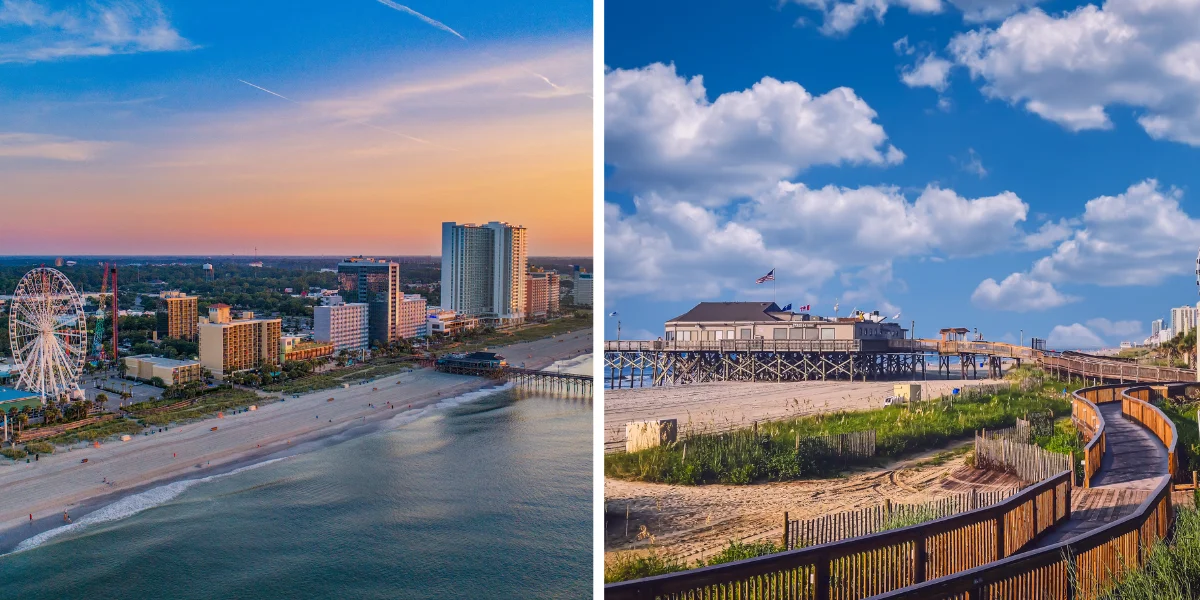
Rent prices in the Myrtle Beach metro run about 17% below the national average, according to 2024 data from the Bureau of Economic Analysis. That makes the Grand Strand one of the more affordable places to rent near the beach while you get to know the area.
Moving to Rock Hill and Fort Mill, SC
Rock Hill and Fort Mill sit just across the state line from Charlotte, and many residents commute up I-77 into the city every day. Census estimates have ranked Fort Mill’s growth rate among the top five in the nation for towns its size, and GOBankingRates ranked the Fort Mill School District 11th in the country.
Rock Hill is the larger of the two, with a historic downtown near Winthrop University and generally lower home prices than Fort Mill. Living on the South Carolina side lets you pay South Carolina’s lower property taxes while still working in Charlotte.
If you live in South Carolina and commute to a job in North Carolina, you’ll file a nonresident return in North Carolina and a resident return in South Carolina each year. South Carolina gives you a credit for the taxes you pay to North Carolina, so you won’t get taxed twice on the same income. A tax professional can help you set up your withholding correctly before your first paycheck.
Retiring in the Carolinas
Both states attract a steady stream of retirees, including plenty of “halfbacks.” That’s the nickname for people who retired to Florida and then moved halfway back north to the Carolinas for milder summers and lower costs.
Best Places to Retire in North Carolina
Wilmington and New Bern give retirees coastal living with good access to healthcare. If you prefer cooler mountain air, Asheville and the surrounding towns have been retirement favorites for decades, and North Carolina’s flat income tax keeps the math simple on pension and retirement account withdrawals.
Best Places to Retire in South Carolina
Myrtle Beach and the rest of the Grand Strand rank among the most popular retirement areas in the state. South Carolina also exempts military retirement pay from state income tax at any age, which is a nice perk for military families who decide to settle near Fort Jackson after their service.
Weather and Hurricane Season in the Carolinas
Winters stay mild across most of both states, and snow rarely sticks around outside the mountains. Summers run hot and humid, so schedule your heavy lifting for early mornings in July and August.
Atlantic hurricane season runs June 1 through November 30, and the most active stretch usually falls between August and October. Storms tend to hit the coast hardest during hurricane season in South Carolina. Hurricane season in North Carolina can also bring serious flooding far inland, as western North Carolina saw during Helene.
If you’re moving to the coast in late summer or fall, build some flexibility into your dates and watch the forecast in the week before your move.
If a storm threatens your moving week, you don’t have to cancel your plans and start over. Go Mini’s can pick up your loaded container and keep it at our secure storage facility until the weather clears and you’re ready for delivery.
Ready for Your Move to the Carolinas?
A move to a new state usually means trying to line up your closing date with your moving day. With Go Mini’s, we drop off a portable storage container at your current home and you pack at your own pace. When you’re ready, we pick it up and either deliver it to your new address in the Carolinas or keep it at our secure facility until your new place is ready.
Need moving storage in the Carolinas? Go Mini’s has local branches across both states:
- Charlotte Metro: Charlotte and Rock Hill
- Mountains and Foothills: Asheville and Hickory
- Central North Carolina: Raleigh, Fayetteville, Goldsboro, High Point and our Reidsville dealer
- North Carolina Coast: Wilmington and Eastern North Carolina
- South Carolina Midlands and Coast: Columbia and Myrtle Beach
Pack at your own pace and let us handle the driving. Get your instant, no-obligation quote today!
Frequently Asked Questions About Moving to the Carolinas
Is it a good idea to move to North Carolina?
For most people, it is. Like anywhere, the pros and cons of living in North Carolina come down to tradeoffs. You’ll get a strong job market and a cost of living below the national average, but you’ll also pay more for housing in the big metros than you would have a few years ago, and coastal homeowners have to plan for hurricane season every year.
What is the biggest risk of living in North Carolina?
Hurricanes and the flooding they bring are the biggest natural risk. Coastal towns usually take the most direct hits, but Hurricane Helene showed in 2024 that heavy rain can cause severe flooding in the mountains, too. Check flood zone maps and talk to an insurance agent before you buy a home anywhere in the state.
What salary is needed to live comfortably in North Carolina?
A 2026 SmartAsset study found that a single adult needs about $93,475 a year to live comfortably in North Carolina. That figure builds in money for savings on top of your basic bills, so plenty of people get by on less, especially outside Charlotte and Raleigh. North Carolina was also one of only six states where that number went down compared to 2025.
What is the #1 safest city in NC?
SafeWise named Rolesville, a small town just northeast of Raleigh, North Carolina’s safest city for 2026. Several other suburbs around Raleigh and Charlotte, including Cary and Waxhaw, also rank near the top of the list.
Is South Carolina a good state to move to?
Plenty of people think so. MoveBuddha’s 2025 moving trends report found nearly twice as many people looking to move to South Carolina as looking to leave. The pros and cons of living in South Carolina include low property taxes and mild winters on one side, with long, hot summers and hurricane risk on the other.
What is the biggest risk of living in South Carolina?
Hurricanes pose the biggest risk, especially for homes along the coast. Inland, heavy rain and flooding usually do more damage than wind. If you’re buying near the water, ask about flood insurance early, since you’ll typically need a separate policy from your standard homeowners coverage.
What salary is needed to live comfortably in SC?
SmartAsset’s 2026 study puts the number at about $92,934 a year for a single adult in South Carolina, just under North Carolina’s figure. Your own budget will depend heavily on where you settle, since homes in Fort Mill or near the beach cost much more than homes in smaller inland towns.
Why are people moving out of SC?
South Carolina still gains far more residents than it loses each year. When South Carolinians do leave, Census data shows North Carolina is their most common destination. People who move away often mention the long, hot summers or rising housing costs in the fastest-growing areas.
Charlotte vs. Raleigh: which city is a better fit?
It depends on your career and the lifestyle you want. Charlotte is the bigger city, with a downtown built around banking and finance. Raleigh’s economy centers on tech and research, and the nearby universities give it more of a college-town feel. Your commute and the jobs in your field will usually decide it.
Is it cheaper to live in North Carolina or South Carolina?
South Carolina usually comes out slightly cheaper overall, mostly thanks to lower property taxes. North Carolina’s flat income tax rate is lower than South Carolina’s top rate, though, so higher earners may pay less in income tax on the North Carolina side of the line.